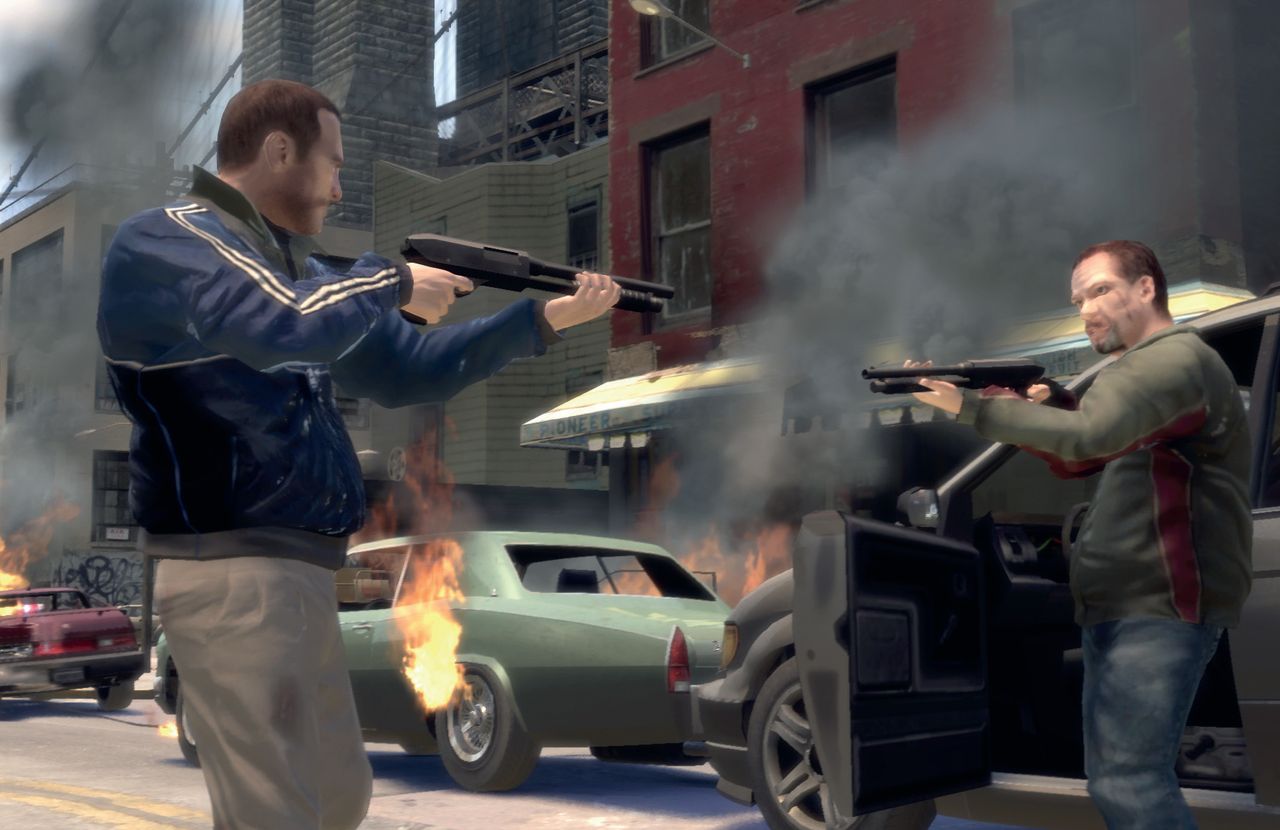
Long before Grand Theft Auto Online became a cultural phenomenon generating billions in revenue, there was a simpler yet equally exhilarating multiplayer experience that captured the hearts of PC gamers everywhere. Grand Theft Auto 4’s multiplayer mode, particularly on PC with its expanded 32-player capacity, offered something that console players could only dream of: pure, unadulterated chaos on an unprecedented scale. Picture this scene from 2009: 32 fire trucks lined up at a starting line, engines revving, with roughly 25 players ready to create what one journalist memorably described as “glorious never-had-anything-like-that-before chaos.”
The PC version of GTA 4, released in late 2008 following its console debut earlier that year, represented a significant leap forward for the franchise. While console versions were limited to 16 players in multiplayer modes, PC gamers enjoyed double that capacity. This seemingly simple numerical increase transformed the entire multiplayer experience, turning Liberty City’s streets into battlegrounds of unprecedented mayhem and hilarity. The additional hardware power of gaming PCs also meant better graphics, smoother framerates, and the inclusion of options that would only become practical as computer technology advanced further.
A Revolution in Open World Multiplayer Gaming
The addition of multiplayer to the Grand Theft Auto series marked a watershed moment in gaming history. Prior to GTA 4’s official multiplayer modes, players seeking cooperative or competitive experiences in the GTA universe had to rely on fan-made modifications like Multitheft Auto, which attempted to bring multiplayer functionality to earlier titles in the series. Rockstar Games’ decision to incorporate multiplayer directly into GTA 4 legitimized what the community had been craving for years. The single-player campaign of GTA 4 took a notably more serious tone compared to previous entries, following the story of Eastern European immigrant Niko Bellic as he navigated the criminal underworld of Liberty City. However, the multiplayer component threw that seriousness completely out the window, allowing players to embrace the chaotic, sandbox nature that had defined the series since its inception.
What made GTA 4’s multiplayer particularly special was how human players transformed the experience. In single-player, the AI-controlled pedestrians and drivers provided predictable responses to player actions. But when real people entered the equation, everything changed. Players would make unexpected decisions, form impromptu alliances, execute elaborate betrayals, and generally behave in ways that no artificial intelligence could replicate. The game’s physics engine, which was revolutionary for its time using the Euphoria system for realistic character movement and reactions, only amplified these moments of emergent gameplay.
Customization and Game Mode Variety
The multiplayer experience offered extensive customization options that kept players engaged for hundreds of hours. Beyond choosing their character’s appearance—including clothing, head type, and gender—players could tweak nearly every aspect of the game modes themselves. The weapons-only restrictions provided some of the most memorable experiences: imagine limiting an entire 32-player Turf War match to rocket launchers only. The slow-moving projectiles required careful aiming and expert timing, but driving a vehicle directly into a crossfire of explosive rounds created unforgettable moments of destruction. The map options were equally diverse, allowing players to restrict battles to small peninsulas for intense close-quarters combat or open up all three islands of Liberty City for sprawling warfare.
Race modes emerged as particular highlights of the multiplayer offering. The GTA Race variant combined traditional racing with vehicular combat, allowing players to attack opponents while speeding through Liberty City’s streets. Comparisons to the classic Road Rash series were inevitable and well-deserved. Players would start in vehicles of similar classes but rarely finish in them—destroyed cars meant respawning on mopeds, leading to desperate underdog runs where a skilled player might overtake a fire truck while simultaneously unloading an Uzi into it. As races progressed and lower-ranked players abandoned hopes of winning, they would often resort to forming roadblocks or attacking race leaders, transforming standard races into Mad Max-style survival scenarios.
The Foundation for Grand Theft Auto Online
Looking back from today’s perspective, GTA 4’s multiplayer clearly served as the experimental foundation for what would eventually become Grand Theft Auto Online—one of the most financially successful entertainment products ever created. The lessons Rockstar learned from GTA 4’s multiplayer informed countless design decisions for GTA Online, from the importance of customizable game modes to the understanding that player-created chaos was often more entertaining than developer-scripted scenarios. The team deathmatch modes, cooperative missions, and free-roam options all found their spiritual successors in GTA Online’s more polished and expansive framework.
The technical achievements of GTA 4’s multiplayer should not be understated either. Managing 32 players simultaneously in a detailed open-world environment presented significant challenges for network infrastructure in 2008-2009. Server performance would occasionally struggle, particularly when those famous 32 fire trucks lined up at a starting line, but the experience remained revolutionary for its time. The game demonstrated that open-world multiplayer could work on a large scale, paving the way for numerous titles that followed. As the gaming industry now eagerly anticipates Grand Theft Auto 6 and its inevitable online component, it’s worth remembering that the foundation of this multiplayer empire was built not in Los Santos, but in the chaotic streets of Liberty City, where fire trucks collided and rocket launchers turned the urban landscape into a playground of glorious chaos.
Expert Opinion: GTA 4’s multiplayer represented a pivotal transitional moment in gaming history, demonstrating that open-world sandbox experiences could successfully incorporate large-scale multiplayer elements. The design philosophy of player freedom and emergent gameplay established here directly influenced not only GTA Online’s subsequent success but also shaped industry-wide expectations for open-world multiplayer games. As Rockstar prepares for GTA 6, the lessons learned from those chaotic 32-player matches in Liberty City remain foundational to their multiplayer design approach.